How often do you still see someone on a roof, or up a ladder, with nothing to stop them falling? If you work in or around construction, the honest answer is: more often than anyone would like to admit. Despite decades of guidance, free advice and well-known rules, unsafe work at height is still happening on sites across the country every single day.
A recent HSE prosecution shows exactly how it happens – and, more usefully, why the failure is so rarely about not knowing the rules.
WHAT HAPPENED
A construction company and its director were fined after workers were put at serious risk during roof work on an extension and refurbishment project in the Kings Cross area of central London.
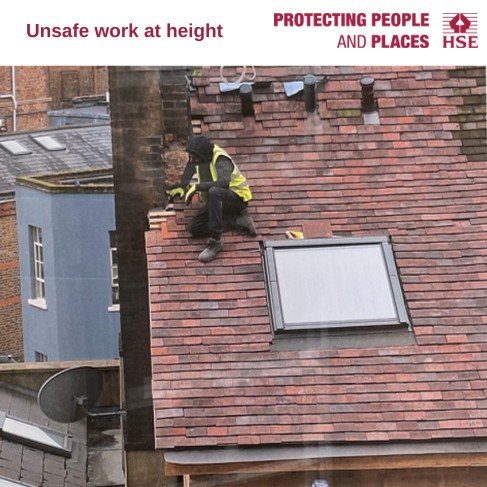
In January 2024, concerned members of the public sent photographs to the HSE showing people working on a roof with no control measures to protect them from falling – no edge protection, and no safe means of access. In the images, operatives were standing on a makeshift platform balanced on a stepladder.
The HSE investigation found there were no controls in place to prevent workers – who were employed by a subcontractor – from falling from height, on at least two separate dates. Crucially, the measures the roofing subcontractor’s own risk assessment had identified as necessary, including scaffolding around the roof, simply weren’t in place.
The company pleaded guilty to breaching Regulation 4(1) of the Work at Height Regulations 2005. The director pleaded guilty to a breach under the Health and Safety at Work etc. Act 1974, by virtue of his role as a director. Both were fined, and the director was ordered to pay costs.
THE PART THAT SHOULD GIVE EVERY MANAGER PAUSE
What makes this case stand out isn’t the unsafe work itself – sadly, that’s common. It’s the history behind it.
This wasn’t a company that had never been told. Between 2021 and 2023, the HSE had responded to several concerns raised by the public and neighbouring occupants, and had taken enforcement action against the businesses involved on more than one occasion. Inspectors had even met with the director specifically to discuss how to improve his management arrangements and achieve sustained compliance.
The director, in the HSE’s words, was fully aware of the requirements for safe work at height, having been given guidance by both the HSE and his own health and safety advisors on several occasions.
And yet, despite all of that, a further concern about unsafe roof work was raised in January 2024.
That’s the uncomfortable lesson. This wasn’t a knowledge gap. The rules were known, the advice had been given, the risk assessment even spelled out the controls needed. What failed was making sure the right things actually happened on site, on the day, every time – and properly supervising the people doing the work.
WHY IT KEEPS HAPPENING
If the knowledge is out there, why is unsafe work at height still so common? In practice, it usually comes down to a handful of familiar pressures:
The “just for five minutes” mindset – the belief that a quick job doesn’t warrant proper access or edge protection. Most falls happen in seconds, and the body doesn’t care whether the task was going to take five minutes or five hours.
Cost and time – scaffolding and proper access take money and planning, and there’s always a temptation to make do with a ladder and improvise.
The gap between paperwork and reality – a risk assessment that correctly identifies scaffolding and edge protection is worthless if nobody ensures those controls are in place before work starts. This case turned on exactly that gap.
Weak supervision – controls slip when no one is actively checking that the safe system of work is being followed.
FALLS FROM HEIGHT: STILL THE BIGGEST KILLER
None of this is a minor or theoretical risk. Falls from height remain the single leading cause of workplace death in Great Britain, accounting for over a quarter of all work-related deaths in 2025/26. It is, year after year, the most common way people die at work – and it is almost always preventable.
HSE guidance is clear that for roof work to be carried out safely there must be, at a minimum, safe access to the roof and a safe place to work on it. For sloping roofs, that usually means full edge protection on all elevations where access is needed, capable of containing someone who slips, including at gable ends.
WHAT GOOD LOOKS LIKE
Preventing this isn’t complicated, and that’s rather the point. The controls are well established and widely available:
Plan the work properly before anyone goes up – decide how the roof will be accessed and how people will be protected, before work starts.
Provide safe access – a proper means of getting onto the roof, not a stepladder with a platform balanced on top.
Fit edge protection wherever a person could fall, on every relevant elevation.
Put the controls your risk assessment identifies actually in place – if it says scaffolding, there needs to be scaffolding. A risk assessment is a plan to act on, not a document to file.
Supervise the work – make sure the safe system is followed every day, not just written down once.
THE TAKEAWAY
The striking thing about this case is that everything needed to prevent it already existed – the rules, the guidance, the advice, even the company’s own risk assessment naming the controls required. It still went wrong, repeatedly, because knowing what to do and making sure it happens on site are two very different things.
So the question worth asking isn’t “do we know the rules on work at height?” It’s the one this case really turned on: would what’s happening on your site right now pass if a member of the public photographed it and sent it to the HSE? If you can’t answer that with confidence, that’s the place to start.
HOW ACREDITSAFE CAN HELP
Making sure work at height is properly planned, the right controls are actually in place, and your teams are genuinely supervised is exactly the kind of support our membership is built around. As an AcreditSafe member you get ongoing professional advice from our team whenever you need it, along with the tools and templates to keep your health and safety on track. If you’d like that kind of support behind your business, get in touch to find out more about becoming a member.
SOURCE
HSE Media Centre – Sentenced: Construction company and director fined for risking lives with unsafe roof work: https://press.hse.gov.uk/2026/08/18/sentenced-construction-company-and-director-fined-for-risking-lives-with-unsafe-roof-work/
This article is based on a reported HSE prosecution and is provided for general information. It is not legal advice.