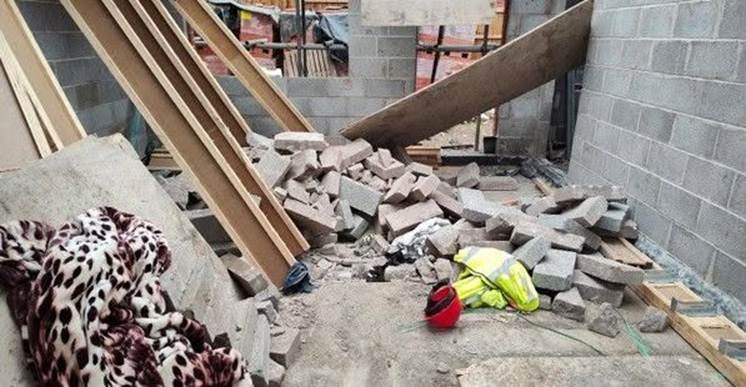
A recent HSE prosecution should give every principal contractor pause. An Oldham-based construction company was fined £30,000 after a 25-year-old bricklayer suffered serious injuries when the floor he was working on collapsed beneath him. He fell from height along with a number of concrete blocks, fracturing his right leg, his hip and his left hand. He needed surgery and spent a month in hospital.
The HSE inspector who investigated used two words that should stay with anyone who runs a construction site: the incident was “entirely foreseeable”. In health and safety, foreseeable means preventable. It means the risk could have been identified and controlled before anyone got hurt. And that is exactly what makes cases like this so frustrating – and so avoidable.
What actually went wrong
On the face of it, the immediate cause was simple. The floor had been overloaded with concrete blocks, and it had not been constructed in accordance with the manufacturer’s design. Put too much weight on a structure that was never built to carry it, and physics does the rest.
But the HSE investigation did not stop at the floor. It found a series of wider failings across the site, and this is the part every contractor should pay attention to. Inspectors identified unsafe scaffolding, inadequate arrangements for work at height, poor standards of good order, a lack of fire alarms, poorly maintained plant and inadequate site management.
That list tells a story. This was not a single freak failure on an otherwise well-run site. It was a site where the basics had been allowed to slip across the board – and the floor collapse was simply where it finally caught up with someone.
The lesson: incidents rarely come from nowhere
One of the most important things we try to get across to the firms we work with is that serious incidents are almost never a bolt from the blue. They are the end point of a series of smaller failures that were tolerated, overlooked or never picked up in the first place.
A site with unsafe scaffolding and poor housekeeping and badly maintained plant is a site that has stopped paying attention to detail. Once that culture sets in, it is only a matter of time before something goes seriously wrong. The floor could just as easily have been the scaffold, or the plant, or a fire with no alarm to warn anyone.
This is why the standard of general site management matters so much. It is not box-ticking. The condition of a site is the single best indicator of whether the people running it have a grip on risk.
What the law expects of a principal contractor
Under the Construction (Design and Management) Regulations 2015 – CDM – the principal contractor carries clear legal duties for the construction phase of a project. In simple terms, you must plan, manage and monitor the work to make sure risks are properly controlled and the job is carried out safely.
Those three words – plan, manage, monitor – are worth breaking down, because they are where most failings actually happen:
Plan. Before work starts, the risks have to be identified and the controls put in place. In this case, that means a floor built to the manufacturer’s design, with proper limits on loading, and safe systems of work for anyone working at height on or around it.
Manage. Plans on paper are worthless if they are not put into practice. Managing means making sure the safe systems of work are actually followed, that scaffolding is erected and inspected correctly, that plant is maintained, and that the site is kept in good order day to day.
Monitor. Sites change constantly. Monitoring means checking, regularly and honestly, that standards are being maintained as the job progresses – and acting quickly when they are not. The failings in this case did not appear overnight. Effective monitoring should have caught them long before the floor gave way.
None of this was expensive or complicated
Here is what should really sink in. Nothing that went wrong on this site required a big budget or specialist knowledge to put right.
Building the floor to the manufacturer’s instructions was free – it was simply a matter of following the design. Loading it within safe limits cost nothing. Putting safe systems of work in place for work at height, keeping the site tidy, maintaining plant, fitting fire alarms – these are the everyday fundamentals of running a construction site, not costly extras.
That is the hard truth behind so many HSE prosecutions. The failings are rarely exotic. They are the basics, neglected. And the cost of getting them right is almost always a tiny fraction of the cost of getting them wrong – a £30,000 fine, a young worker’s shattered leg and hip, a month in hospital, and a life affected long after the headlines fade.
Would your site stand up to scrutiny?
It is an uncomfortable question, but an important one. If an HSE inspector walked onto your site tomorrow, what would they find? Would your scaffolding pass inspection? Are your work-at-height arrangements properly planned and followed? Is your plant maintained and your paperwork in order? Is the site itself in good, safe condition?
For a lot of small and medium contractors, the honest answer is “I think so, but I am not certain” – and that uncertainty is exactly where risk lives. Not because these firms do not care about safety, but because they are busy running jobs, and there is rarely time to step back and check everything properly.
That is precisely the gap we help fill. Whether it is planning and managing the construction phase under CDM, carrying out independent site inspections to catch the problems before an inspector does, getting your RAMS and safe systems of work right, or simply being on the end of the phone when you need advice, our job is to help you run a site that would stand up to scrutiny – and, far more importantly, one where your people go home safe at the end of every shift.
Because “entirely foreseeable” should never be the verdict on your site.
You can read the full HSE report on this case here: https://ow.ly/YOgi50ZAMpv
If you would like to talk about how AcreditSafe can support your health and safety obligations as a principal contractor, get in touch – we work with construction and trades firms across the UK to keep their sites safe, compliant and running smoothly.