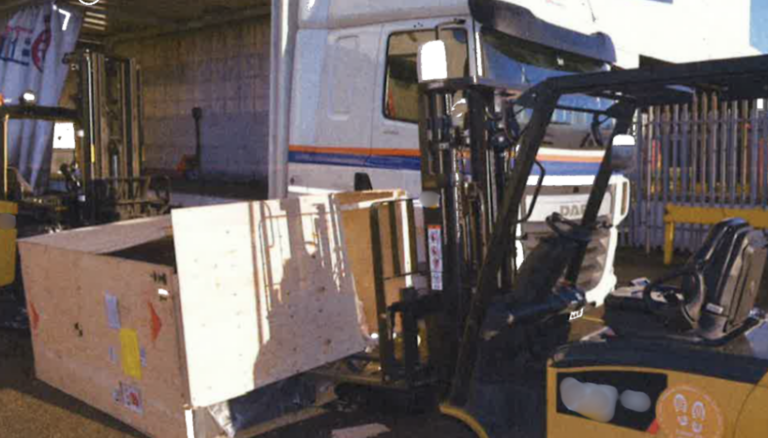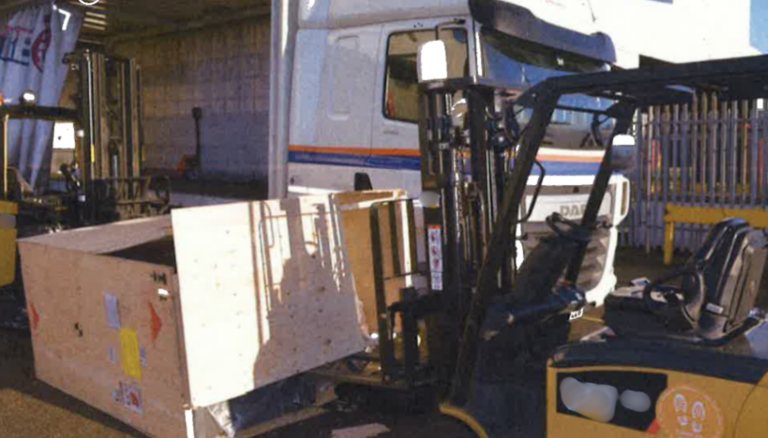
A worker suffered life-changing injuries when a 1.2-tonne crate fell from a forklift truck. The company was fined £230,000. And the reason it happened comes down to one thing that catches businesses out again and again: the arrangements changed, but the safety planning didn’t change with them.
It’s a case every business that lifts, moves or takes delivery of heavy loads should take note of – because the failure wasn’t exotic or unforeseeable. It was a task that got handed over at short notice and never properly planned.
WHAT HAPPENED
A delivery driver arrived at a medical company’s site to deliver a large crate containing an electron microscope, weighing approximately 1.2 tonnes.
Originally, the delivery firm had intended to unload the crate themselves, using their own forklift truck and driver. But during the COVID-19 pandemic, the receiving site wanted to reduce the number of people on site, and so took on responsibility for unloading the goods instead.
That task was not properly assessed, planned or supervised. The load was lifted unsafely, the worker was positioned in an unsafe place, and the crate fell from the forklift and landed on him, causing life-changing injuries.
The HSE investigation found the company had failed to adequately plan the unloading. There was no assessment of whether its two-tonne forklift was suitable for the characteristics of that particular load. There was no consideration of how the lift should be carried out, who should be involved, or what precautions were needed. And the operation was not meaningfully controlled or supervised.
The company was found guilty of breaching Section 3(1) of the Health and Safety at Work etc. Act 1974 – the duty to protect people who are not your employees. It was fined £230,000 and ordered to pay £111,000 in costs.
THE LESSON: CHANGED CIRCUMSTANCES DON’T CHANGE YOUR DUTIES
The most important part of this case is why the unloading went wrong. It wasn’t a task the business did every day and got complacent about. It was the opposite – a task they didn’t normally do, that they took on at short notice because circumstances had changed.
The HSE inspector’s comment cuts straight to it: the safety requirements did not change just because the normal delivery arrangements had changed. If the site wasn’t going to be involved in unloading, that should have been clearly specified. If they were going to take part – including guiding or supervising a lift – then the arrangements to do that safely should have been defined, along with the precautions to protect everyone involved.
This is the trap that catches so many businesses. Systems and safe methods tend to be built around how things normally happen. But work rarely stays “normal.” Someone is off, a supplier changes, a delivery arrives differently, a job gets handed from one party to another, or a one-off situation crops up that nobody planned for. In that moment, the temptation is to just get on with it – “we’ll sort it ourselves this once.”
But the risk doesn’t reduce when the plan changes. If anything it increases, because now people are carrying out a task they haven’t prepared for, possibly with equipment that wasn’t chosen for the job, and without the usual controls in place.
WHY LIFTING OPERATIONS ARE SO UNFORGIVING
Lifting operations put people at serious risk when they go wrong, and the consequences are severe. A heavy, awkward or unfamiliar load – like a 1.2-tonne crated microscope – behaves very differently from a routine palletised delivery. Its weight distribution, stability and the way it needs to be handled all matter, and getting any of it wrong can be catastrophic for anyone standing nearby.
HSE guidance is clear that because lifting operations carry such potential for harm, they must be properly resourced, planned and organised so they are carried out safely. That applies especially to non-standard loads, where a generic “we’ll use the forklift” approach isn’t good enough.
In this case, the essentials were missing:
The load wasn’t assessed – no one checked whether the two-tonne forklift was suitable for that specific 1.2-tonne crate and how it was packed.
The method wasn’t planned – there was no clear decision on how the lift would be done, step by step.
The roles weren’t defined – no one had established who should be involved, or who was responsible for what.
There was no supervision – nobody was meaningfully controlling the operation as it happened.
WHAT GOOD LOOKS LIKE
Preventing this doesn’t require anything elaborate. It requires stopping and thinking before a lift, particularly when it’s not a routine one:
Plan every non-routine lift as its own task. A one-off, an unusual load, or a job that’s been handed over deserves a proper think, not an assumption that it’ll be fine.
Assess the load and the equipment. Know the weight and characteristics of what’s being lifted, and confirm the lifting equipment is actually rated and suitable for it.
Define who does what. Be clear on who is carrying out the lift, who is supervising, and what everyone else should be doing – including keeping clear.
Keep people out of the danger zone. Many lifting injuries happen to the person nearby, not the operator. Nobody should be within reach of a load that could fall.
Supervise it. Someone competent should be overseeing the operation to make sure it goes to plan and to stop it if it doesn’t.
Write it down where the risk warrants it. A risk assessment proportionate to the hazard – covering the load, the equipment and the arrangements – is exactly what was missing here.
And crucially: apply all of this precisely when circumstances change. A handover, a staff absence, a one-off delivery or an unusual load is the moment to plan more carefully, not less.
THE TAKEAWAY
Life-changing injuries. A £230,000 fine. A 1.2-tonne crate that fell because a task got handed over and never properly planned. The controls that would have prevented it – assess the load, choose the right equipment, define the roles, supervise the lift – are straightforward and well understood.
The real lesson is about what happens when the normal way of doing things gets disrupted. That’s exactly when businesses need to stop and re-plan, because their legal duties and the physical risks don’t pause just because the circumstances have changed. If your business handles heavy or awkward loads – or takes delivery of them – it’s worth asking honestly: when the plan changes, does the planning change with it?
HOW ACREDITSAFE CAN HELP
Making sure your lifting operations are properly planned, your equipment is suitable, and your team knows how to handle non-standard tasks safely is exactly the kind of support our membership is built around. As an AcreditSafe member you get ongoing professional advice from our team whenever you need it, along with the tools and templates to keep your health and safety on track. If you’d like that kind of support behind your business, get in touch to find out more about becoming a member.
SOURCE
HSE Media Centre – Crate falls from forklift truck and seriously injures worker: https://press.hse.gov.uk/2026/09/15/crate-falls-from-forklift-truck-and-seriously-injures-worker/
This article is based on a reported HSE prosecution and is provided for general information. It is not legal advice.