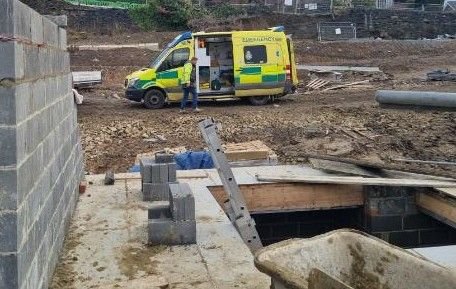
A 24-year-old labourer, in only his second week on the job, stepped backwards and fell through an unprotected stairwell opening. He dropped a full storey onto concrete, was knocked unconscious, and had to be rescued by the fire service. The spinal injuries he suffered have stopped him returning to physical work. The company was fined £300,000.
It’s one of those cases that’s hard to read, precisely because it was so simple to prevent. There was no complex machinery, no unusual hazard – just a hole in the floor that nobody had secured. And it points to a risk that is still catching people out on construction sites across the country: openings in floors.
WHAT HAPPENED
A domestic house builder was fined after a temporary labourer suffered serious spinal injuries on a site where four new homes were being built.
It was the worker’s second week on the job. As he moved around the site, he stepped backwards and fell through an opening that had been left for a staircase not yet installed, dropping one storey onto the concrete sub-floor below. He was knocked unconscious, and the fire and rescue service, along with a specialist rescue team, had to recover him. His injuries were serious and life-changing – he was unable to work for months afterwards and has not returned to a physical job since. He is a father of one.
The HSE investigation found the cause was straightforward. The stairwell opening had not been securely covered – scaffold boards that had previously been over it were removed and not replaced – and the open edges were not protected. There was no safe arrangement in place to stop someone falling through.
The company was found guilty of three charges: failing to properly plan work at height, failing to appropriately supervise it, and failing to take suitable and sufficient measures to prevent a fall. It was fined £300,000 plus costs.
The HSE inspector described it as a wholly avoidable incident caused by basic failures in planning and supervision, noting that simply securing the boards or installing edge protection would have prevented the worker from falling.
WHY FLOOR OPENINGS ARE SUCH A COMMON TRAP
When people think about falls from height, they picture roofs, scaffolds and ladders – working up high, near an obvious edge. But some of the most serious falls happen through openings in floors: stairwell voids, lift shafts, service risers, loft hatches, and holes left for ducts or future installations.
These are dangerous for a few specific reasons:
They don’t look like a “height” hazard. A hole in an otherwise solid floor doesn’t trigger the same instinctive caution as standing near a roof edge, so people work around it with their guard down.
Covers get moved and not replaced. Openings are often covered, but the cover gets lifted for access, materials or another trade’s work – and doesn’t get put back, or gets replaced with something that isn’t secured or strong enough.
They catch out the people who don’t know the site. A new starter, a visitor, or someone from another trade has no reason to know a particular opening is there. In this case, a worker in only his second week had no way of knowing what was behind him.
People step backwards. Falls through openings frequently happen when someone moves backwards or sideways while concentrating on a task, straight into an opening they’d forgotten or never knew about.
WHAT THE LAW REQUIRES
Under the Work at Height Regulations 2005, work at height – which specifically includes work where a person could fall through an opening or fragile surface – must be properly planned, appropriately supervised, and carried out safely. Employers must take suitable and sufficient measures to prevent falls.
For floor openings, that means physical safeguards: either a secure, fixed cover that is strong enough to take the loads placed on it and clearly marked, or edge protection (guardrails) around the opening. It also means planning the work so that openings are identified and protected from the outset, and supervising it so that protection stays in place as the job progresses and different trades come and go.
WHAT GOOD LOOKS LIKE
Protecting floor openings isn’t difficult or expensive – which is exactly why incidents like this are so avoidable. The essentials are:
Cover or guard every opening. Every opening should be either securely covered or protected with guardrails – no exceptions, from the largest stairwell void to the smallest service hole.
Fix covers down and mark them. A cover that can be kicked, slid or lifted out of the way isn’t a control. Covers should be secured in place, strong enough for the environment, and clearly marked so everyone knows what’s underneath.
Make replacement someone’s clear responsibility. If a cover has to be lifted for access, it must be part of the system of work that it goes straight back and is checked – and someone owns that.
Plan and inspect. Identify openings at the planning stage, protect them from the start, and check them regularly as the build progresses and trades change.
Brief everyone, especially new and visiting workers. People who don’t know the site need to be told where the hazards are. A proper induction and ongoing supervision are what protect the person in their first or second week.
THE TAKEAWAY
A fixed-down cover, or a bit of edge protection, takes minutes and costs very little. The absence of it cost a 24-year-old his career and left a company facing a £300,000 fine and a prosecution that will follow it for years.
Falls from height remain one of the leading causes of death in construction, accounting for around a quarter of all worker deaths each year – and openings in floors are one of the most avoidable versions of that risk. If you run or manage a site, the question is simple: is every opening on it either securely covered or guarded right now, and would someone in their second week be safe walking across that floor?
HOW ACREDITSAFE CAN HELP
Making sure work at height is properly planned, openings and edges are protected, and your teams – including new starters – are properly briefed and supervised is exactly the kind of support our membership is built around. As an AcreditSafe member you get ongoing professional advice from our team whenever you need it, along with the tools and templates to keep your health and safety on track. If you’d like that kind of support behind your business, get in touch to find out more about becoming a member.
SOURCE
HSE Media Centre – Construction company fined after 24-year-old father falls through unprotected stairwell opening: https://press.hse.gov.uk/2026/09/21/construction-company-fined-after-24-year-old-father-falls-through-unprotected-stairwell-opening/
This article is based on a reported HSE prosecution and is provided for general information. It is not legal advice.