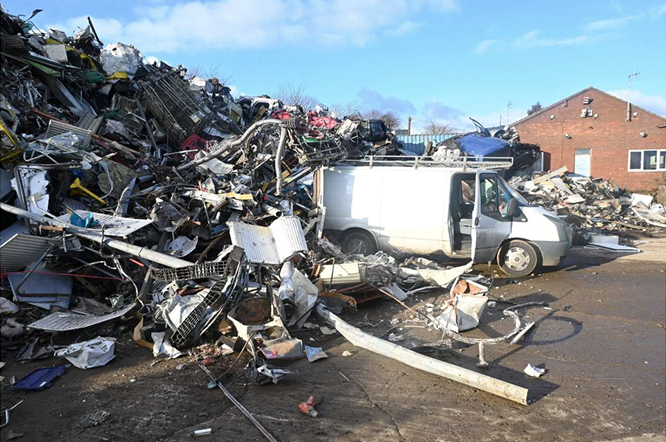
Ten days before a father and son were buried under a collapsing pile of scrap metal, the same machine had already given a warning. Its cab had swung into a member of the public’s vehicle. Nobody was hurt that time – so nothing changed. Ten days later, luck ran out.
It’s a case that carries two of the most important lessons in workplace safety at once: keep people away from moving machinery, and never ignore a near miss. A recent HSE prosecution shows, in the starkest terms, what happens when a business gets both wrong.
What happened
A scrap metal recycling company was fined after two members of the public were seriously injured at its site. A father and son had arrived to drop off scrap and were unloading their vehicle when a 360-degree excavator, fitted with a grab attachment, began removing material from a nearby stockpile.
As the machine worked the pile, part of the stockpile collapsed, sending heavy pieces of scrap metal down onto the two men. Both were taken to hospital. One suffered a broken leg.
The HSE investigation found that the excavator had been operating in close proximity to the two members of the public for around 20 minutes before the collapse. The company had failed to put suitable controls in place to keep the public away from the risks created by moving machinery and unstable stockpiles.
The company pleaded guilty to breaching Section 3(1) of the Health and Safety at Work etc. Act 1974 – the duty to protect people who are not your employees, including members of the public, from risks arising from your work. It was fined £40,000 and ordered to pay costs.
The HSE inspector’s assessment was unflinching: the two men were fortunate not to have been even more seriously injured or killed, and the incident was entirely avoidable.
The warning that was already there
The detail that makes this case so striking is what happened ten days earlier.
On an earlier occasion, the rotating cab of the very same excavator had struck the side of a member of the public’s vehicle as they unloaded scrap. No one was harmed. On paper, it was a lucky escape – a near miss.
But it wasn’t really luck. It was the same underlying failure: members of the public sharing space with a large, moving machine, with nothing effective keeping them apart. The near miss was the system showing exactly where it was going to fail. The only thing that differed between that day and the day of the collapse was consequence.
Had that near miss been treated as the warning it was – had someone stopped, looked at why a machine was able to strike a member of the public, and fixed it – the collapse that followed would almost certainly never have happened. As the HSE inspector put it, with suitable controls in place, both the injury and the earlier near miss would have been avoided.
This is the single most valuable thing a near miss offers: a chance to fix the problem before it hurts someone, at no cost. Ignored, it becomes the accident you were warned about.
The core failure: people and plant sharing space
Strip the case back and the root cause is simple. People on foot were in the same space as heavy moving machinery, and there was nothing effective to keep them apart.
Workplace transport – excavators, forklifts, loading shovels, delivery vehicles, and the like – is one of the biggest causes of serious and fatal workplace injury in the UK. And the mechanism is almost always the same: a person on foot and a moving machine occupying the same ground at the same time. When that happens, the margin for error is tiny, and the consequences are severe.
HSE guidance on workplace transport safety (HSG136) is clear that pedestrians and vehicles should be segregated so far as is reasonably practicable. For any site where vehicles, plant and people mix – waste and recycling yards, builders’ merchants, construction sites, warehouses, farms – suitable traffic management is not an optional extra. It’s one of the most fundamental controls there is.
What good looks like
The striking thing about this case is that the fixes weren’t complex or expensive. After the incident, the company introduced exactly the measures that should have been there from the start:
- A separate, designated area for members of the public to unload, away from the working machinery.
- Clear signage.
- A supervised unloading system.
- A traffic management plan with barriered walkways keeping people physically separated from plant.
None of that is exotic. All of it was entirely possible before anyone was hurt. That’s the hard truth of most workplace transport incidents – the controls that would have prevented them are usually straightforward, well understood, and affordable. What’s missing is the decision to put them in place before, rather than after, someone is injured.
If your site mixes people and moving vehicles or plant, the questions to ask are direct:
- Are pedestrians physically kept apart from moving vehicles and machinery, wherever it’s reasonably practicable?
- Where they must interact, is it controlled – designated areas, supervision, signage, safe routes?
- Do visitors and members of the public, who don’t know your site, get extra protection rather than less?
- And when something nearly goes wrong, does anything actually change as a result?
The takeaway
Two people went to hospital, one with a broken leg, because a business let the public share space with a moving excavator – and because a warning ten days earlier was allowed to pass without action. Both failures were avoidable. Both are common.
The lesson is twofold and it’s worth stating plainly. First, keep people and plant apart – it is one of the most basic and most important controls on any site where the two mix. And second, treat every near miss as what it is: a free warning, telling you where your next serious accident will come from. The businesses that act on those warnings prevent the incident. The ones that file them away find out the hard way.
How AcreditSafe can help
Getting traffic management right, keeping people safe around vehicles and plant, and building a culture where near misses are acted on rather than ignored is exactly the kind of support our membership is built around. As an AcreditSafe member you get ongoing professional advice from our team whenever you need it, along with the tools and templates to keep your health and safety on track. If you’d like that kind of support behind your business, get in touch to find out more about becoming a member.
Source
- HSE Media Centre – Scrap yard fined after father and son injured by collapsing metal pile: https://press.hse.gov.uk/2026/09/02/scrap-yard-fined-after-father-and-son-injured-by-collapsing-metal-pile/
- HSE – HSG136: A guide to workplace transport safety: https://www.hse.gov.uk/pubns/priced/hsg136.pdf
This article is based on a reported HSE prosecution and is provided for general information. It is not legal advice.