
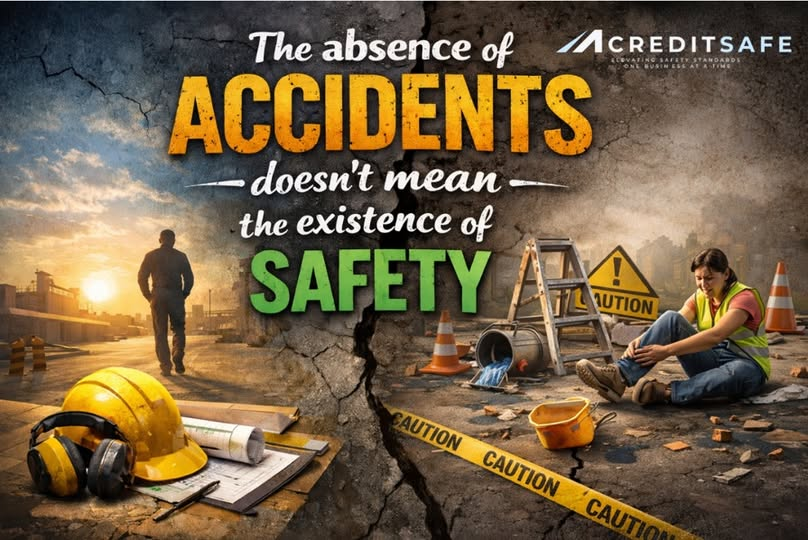
For many businesses, safety is often judged by one simple metric: “We’ve never had an accident.”
On the surface, that sounds reassuring. A clean accident record feels like proof that things are being done correctly. But in reality, it can be one of the most misleading indicators of safety performance.
The uncomfortable truth is this: an absence of accidents often reflects good fortune, not good control.
When luck is mistaken for safety
In almost every serious incident, there is a familiar backstory.
The unsafe condition had existed for months or even years. The shortcut had become normal. The risk assessment hadn’t been reviewed since the project changed. The task had been done “this way” countless times before without issue.
Until one day, circumstances aligned.
Someone slipped, fell, was struck, trapped, exposed, or seriously injured — not because the risk was new, but because the margin for error finally disappeared.
Safety failures are rarely sudden. They are usually slow, quiet, and invisible until the moment they cause harm.
Stay on top of all things Health & Safety with our useful newsletter
(no spam, just all things H&S):

Near misses don’t show up in statistics
Most organisations experience far more near misses than actual accidents. Tools dropped but missed people. Vehicles reversing a little too close. Ladders that shift but don’t collapse. Cuts, strains, and shocks that are brushed off and never reported.
These events rarely make it into dashboards or KPIs, but they are often the clearest warning signs that something isn’t right.
When near misses aren’t recognised, investigated, and learned from, businesses lose the opportunity to fix problems before they become incidents.
A low accident rate can sometimes hide a high-risk environment.
Paper safety vs real safety
Another common issue is the gap between what’s written down and what actually happens on site.
Risk assessments and method statements are often created once, filed away, and never properly revisited. They may look compliant on paper but fail to reflect real working conditions, time pressures, or behavioural shortcuts.
Real safety lives in day-to-day decisions:
- How people actually carry out tasks
- Whether supervisors challenge unsafe behaviour
- If workers feel able to stop a job that doesn’t feel right
- How changes are managed when work doesn’t go to plan
If safety only exists in documents, it doesn’t exist at all.
Why professional safety advice matters
This is where professional health and safety support adds genuine value.
An experienced safety consultant brings something internal teams often can’t: a fresh, objective view. They spot risks that have become normalised, ask uncomfortable questions, and challenge assumptions that go untested.
Professional advice helps businesses:
- Identify hidden or emerging risks
- Align paperwork with real working practices
- Stay compliant with changing legislation and standards
- Improve safety culture, not just documentation
- Reduce the likelihood of costly incidents, enforcement action, and downtime
Good safety advice isn’t about stopping work — it’s about enabling work to be done safely, efficiently, and confidently.
The real cost of getting it wrong
When an accident does happen, the impact reaches far beyond the injured person.
Work stops. Investigations follow. Clients lose confidence. Reputations are damaged. Insurance premiums rise. Directors and managers face scrutiny, stress, and potential legal consequences.
Many of these outcomes are preventable.
Businesses that invest in proactive safety management are not just protecting people — they are protecting continuity, credibility, and long-term success.
Moving from reactive to proactive safety
Strong safety performance doesn’t come from waiting for something to go wrong. It comes from:
- Regularly reviewing risks as work changes
- Encouraging open reporting of near misses
- Challenging unsafe norms and shortcuts
- Investing in competent advice and training
- Treating safety as a leadership responsibility, not an admin task
The safest organisations are rarely the quietest ones. They are the ones constantly asking, “What could go wrong here?” — and doing something about it.
A final thought
A lack of accidents is not proof of safety.
Safety is found in the systems, behaviours, and decisions that prevent harm — even when no one is watching and nothing has gone wrong yet.
At Acreditsafe, we support businesses in building practical, proportionate safety systems that work in the real world — not just on paper.
If you’re relying on past luck as reassurance, it may be time to take a closer look.
www.acreditsafe.com/services